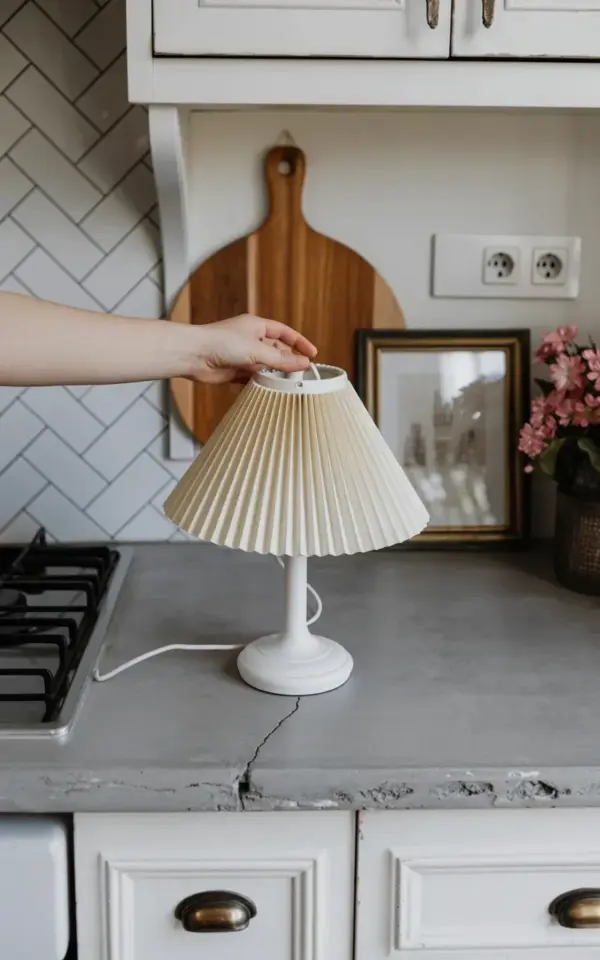
It’s oddly satisfying how one small twist of a lampshade can change the entire mood of a room. I spent weeks staring at my kitchen counter thinking the space just felt dull, especially after sunset. Then I moved a table lamp over from the living room, angled the pleated shade just a few degrees, and everything softened in a way I didn’t expect. Seriously, this table lamp styling trick took about five seconds, and it turned the whole counter into the coziest spot in the house.
The photo I shared on Pinterest shows the exact moment I figured this out. That white pleated table lamp, the gray concrete countertop, and the warm glow bouncing off the brass handles on the cabinet behind it. It wasn’t a lighting plan. It honestly wasn’t even a conscious decision. I just reached out, tilted the shade so the light spilled forward instead of straight up, and the kitchen suddenly looked like a scene from a slow Sunday morning.
The Fastest Fix for Flat Kitchen Counter Lighting
Flat lighting is a real problem in most kitchens, and people don’t talk about it enough. Overhead recessed lights or a single pendant create harsh shadows and make the counter feel like a workspace, not a place you actually want to linger. You end up with a bright room but no warmth.
Table lamp adjustment is the most underrated solution to this. Giving the shade a gentle pull or a slight rotation changes the direction of the light entirely. It creates pools of illumination where you actually need them, like next to the coffee maker or beside a bowl of fruit. No dimmer switch, no new fixture, no electrician. Honestly, it’s a dumb little fix that works every single time.
How to Angle a Pleated Shade for a Warm Glow
The trick is all in the wrists. You want to tilt the shade so the light hits the surface of the counter, not your eyes and not the ceiling. Think of it like aiming a flashlight in a dark room. You’re not just turning it on, you’re pointing it at something specific.
For a pleated fabric shade like the one on my white ceramic base lamp, the effect is even better because the material diffuses the light. The fabric catches the glow and spreads it out softly. If you position the shade so the inner rim is parallel to the counter edge, you get this gorgeous, wide pool of warm light that makes the whole corner feel intimate. It’s a tiny change with a really noticeable payoff.
Why a Table Lamp Belongs on Your Kitchen Counter Decor
A lot of people think table lamps are only for living rooms or bedrooms. That’s a mistake. The kitchen counter is actually one of the best places for a lamp because it’s where you actually spend your time, whether you’re cooking, paying bills, or just leaning against the counter with a cup of tea.
The lamp in my photo sits on a cement countertop, which sounds like an odd pairing but works beautifully. The cool gray of the concrete balances the warm cream of the fabric shade. That contrast between textures, soft fabric against hard stone, is what makes kitchen counter decor feel intentional. It’s not about adding clutter. It’s about adding a layer of light and character that a permanent fixture just can’t provide.
The Best Table Lamp Angle for Cozy Kitchen Lighting
There is a sweet spot for the angle, and it depends on what you’re doing. For general ambience, angle the shade slightly downward and away from your face. For reading a recipe off a tablet or a cookbook, tilt it directly toward the page.
Look, I’m not gonna lie, I have a specific angle I default to now. I tilt the white shade just enough that I can see the texture of the wooden cutting board hanging on the wall behind it. The light catches the grain of the wood and plays off the brass cabinet handles, and the whole scene just glows. If you’re unsure, start with a 30-degree tilt and adjust from there. You’ll know it’s right when you stop noticing the harshness of the room and start noticing the warm spots.
Mixing Lamp Light with Existing Kitchen Decor Ideas
One thing I learned is that a lamp doesn’t fight your existing decor, it just makes it look better. The brass handles on my white cabinets catch the warm light and reflect it in these tiny, beautiful glints. The circular wood cutting board on the wall adds a natural element that the light brings out. Even the pink flowers peeking into the frame on the right side of the counter look richer when the lamp is angled toward them.
Here are a few things to keep in mind when you’re placing your own lamp:
– Make sure the lamp base is sitting on a dry, heat-safe surface (I learned that one the hard way next to the stove).
– Don’t overcrowd the area; one lamp and a small plant or flowers is usually enough.
– Choose a shade that isn’t too dark, a white or cream liner will bounce more light than a black one.
– Angle the shade before you leave the room, and you’ll come back to a much nicer atmosphere.
The goal isn’t to replicate a showroom, it’s to make your actual kitchen feel like a place you want to be. A lamp on a counter is an excuse to use the space for more than just food prep. It’s a signal to slow down.
Using Color Temperature to Boost Interior Lighting Tips
The bulb inside the lamp matters just as much as the angle. A bright white daylight bulb will ruin the whole cozy effect, no matter how perfectly you tilt the shade. I swapped mine for a warm white LED bulb, around 2700K, and it made the biggest difference for the cozy kitchen lighting effect I wanted.
The warm tone pairs beautifully with the cream pleated shade and the gray countertop. It turns the whole area into a golden little nook. If your lamp is currently using a leftover bulb from a desk lamp, go change it right now. It’s a two-minute fix that changes everything. The fabric shade will diffuse the light, and the warm color temperature will do the heavy lifting for the mood.
Kitchen Counter Styling Mistakes to Avoid
Now let’s talk about what not to do, because I’ve made these exact mistakes. Don’t push the lamp all the way against the back wall. That just creates a weird shadow and a glare spot. Give it a few inches of breathing room so the light can sweep across the counter surface. Also, don’t use a lamp that’s too tall or too short for the space. The bottom of the shade should roughly align with your line of sight when you’re standing at the counter. Mine sits lower, and it works, but that rule of thumb isn’t bad.
Another mistake is ignoring the scale of your decor. A tiny lamp on a massive island gets lost. My white ceramic base lamp has some visual weight to it, so it anchors the corner of the concrete counter without looking like an afterthought. And whatever you do, don’t use a lampshade with a dark liner if you’re trying to brighten things up. You’ll end up with a ceiling spotlight and a shadowy counter. That’s the opposite of what you’re going for.
In the end, this is one of those ridiculous little interior lighting tips that feels too simple to be true. But it works. The quickest fix for flat kitchen lighting is just adjusting the lamp you already own. Walk over to your kitchen, find a lamp, give the shade a little twist, and watch how the room changes. Then come back and tell me I was wrong. I’m waiting.
Leave a Comment